
If your practice supplies Durable Medical Equipment, Prosthetics, Orthotics, or Supplies (DMEPOS) and bills Medicare or Medicaid for those items, accreditation isn’t optional — it’s a federal requirement. Yet many practices underestimate how detailed and time-consuming the DMEPOS accreditation process actually is, leading to delayed billing privileges, failed surveys, or even suspended Medicare enrollment.
In this guide, we break down what DMEPOS accreditation involves, which organizations handle it, and the five essential steps your practice needs to follow to get accredited without unnecessary delays.
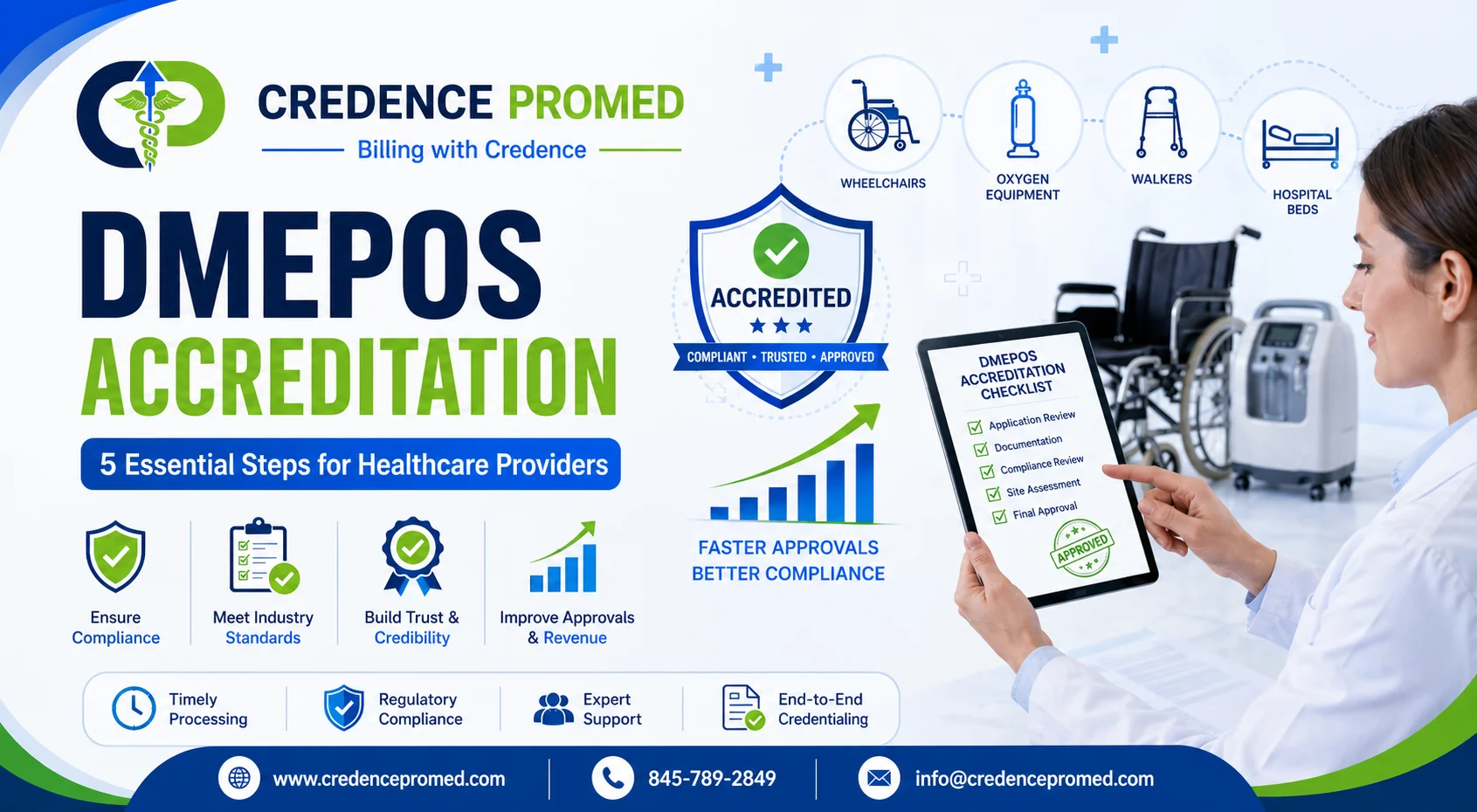
What Is DMEPOS Accreditation?
DMEPOS accreditation is the process by which a supplier of durable medical equipment, prosthetics, orthotics, and supplies is evaluated and certified by a CMS-approved accrediting organization to confirm it meets federal quality and safety standards. Medicare requires this accreditation before a supplier can enroll and bill for DMEPOS items — without it, claims will be denied regardless of medical necessity or documentation quality.
This applies to a wide range of suppliers, including orthopedic practices, home health equipment providers, respiratory therapy suppliers, prosthetic and orthotic clinics, and pharmacies that dispense DME.
Why DMEPOS Accreditation Matters
- No accreditation, no Medicare billing. CMS will not issue or maintain a supplier number without current, valid accreditation.
- Patient safety and quality standards. Accreditation verifies that a supplier follows proper equipment fitting, maintenance, and patient education practices.
- Ongoing compliance risk. Accreditation isn’t a one-time event — as of January 1, 2026, CMS has moved from a three-year renewal cycle to annual resurvey and reaccreditation for most DMEPOS suppliers, along with maintaining supplier standards in between.
- Surety bond requirement. Most DMEPOS suppliers must also maintain a $50,000 surety bond as part of their Medicare enrollment, tied directly to active accreditation status.
Recognized DMEPOS Accreditation Organizations
CMS maintains a list of approved accrediting organizations that suppliers can choose from. The most commonly used include:
- ACHC (Accreditation Commission for Health Care)
- BOC (Board of Certification/Accreditation)
- CHAP (Community Health Accreditation Partner)
- The Compliance Team
- Healthcare Quality Association on Accreditation (HQAA)
Each organization has its own survey process, fee structure, and timeline, but all are required to evaluate suppliers against the same CMS Quality Standards.
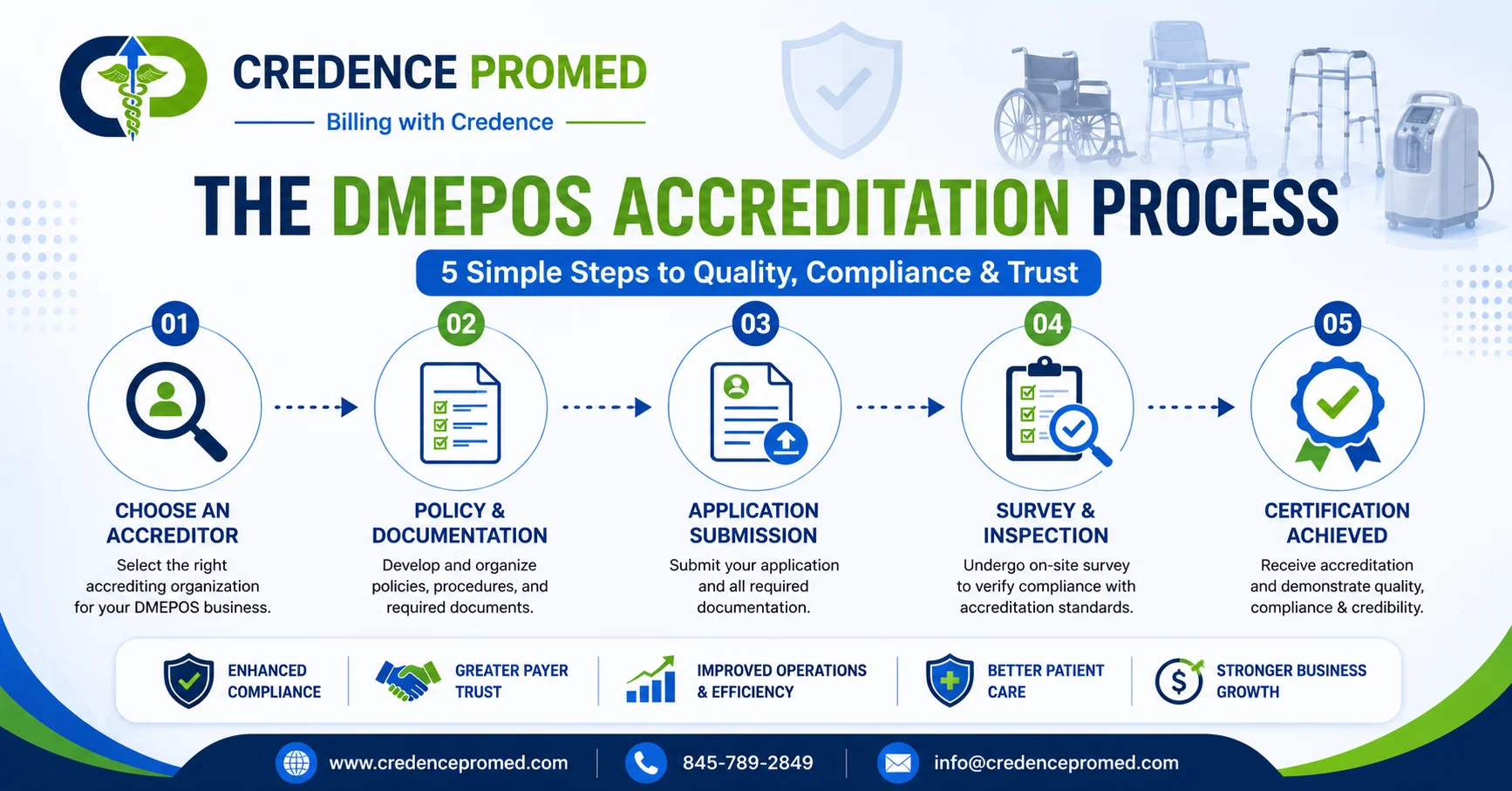
The DMEPOS Accreditation Process: Step-by-Step
| Step | What Happens | Typical Timeframe |
|---|---|---|
| 1. Select an Accrediting Organization | Choose a CMS-approved accreditor based on cost, timeline, and specialty fit | 1–2 weeks |
| 2. Prepare Policies & Documentation | Develop required policies covering patient rights, equipment maintenance, staff training, and complaint handling | 2–4 weeks |
| 3. Submit Application | Complete the accreditor’s application with business, staffing, and facility details | 1 week |
| 4. On-Site or Virtual Survey | Accreditor evaluates facility, records, and processes against CMS Quality Standards | 30–60 days |
| 5. Certification & Medicare Enrollment | Receive accreditation certificate and submit it with your Medicare enrollment application (Form 855S) | 2–4 weeks |
Altogether, the full process typically takes 90 to 120 days, so starting well before you plan to bill Medicare for DMEPOS items is critical.
Common Mistakes That Delay DMEPOS Accreditation
- Incomplete policy manuals — missing required sections on patient complaints, equipment cleaning, or staff competency documentation
- Underestimating survey prep time — treating the on-site survey as a formality rather than a full compliance review
- Letting accreditation lapse — missing your resurvey window (now annual for most suppliers under 2026 CMS rules), which can suspend billing privileges
- Confusing accreditation with licensing — state DME licensing and CMS accreditation are separate requirements; both are often needed
- Not maintaining the surety bond — a lapsed bond can invalidate Medicare enrollment even if accreditation is current
How Credence Promed Can Help
Navigating DMEPOS accreditation alongside daily practice operations is a heavy lift for most billing and administrative teams. Credence Promed’s DMEPOS Billing, Audit and Accreditation service is built specifically to support suppliers through this process:
- Accreditation readiness support — helping prepare the policies, documentation, and staff training records accrediting organizations require
- Audit support — conducting internal reviews before your official survey to catch gaps early
- DME billing expertise — ensuring claims are submitted correctly once accreditation and enrollment are active, reducing denials tied to documentation or coding errors
- Ongoing compliance monitoring — tracking renewal deadlines so your accreditation and surety bond never lapse
- End-to-end Medicare enrollment support — assisting with Form 855S submission alongside your accreditation certificate
Whether you’re pursuing DMEPOS accreditation for the first time or managing a renewal, Credence ProMed helps ensure the process moves smoothly and your billing privileges stay uninterrupted.
Frequently Asked Questions
How long does DMEPOS accreditation take?
Most suppliers complete the process in 90 to 120 days, depending on the accrediting organization and how prepared the practice is going in.
Which accrediting organizations does CMS approve for DMEPOS?
CMS maintains a list of approved organizations, including ACHC, BOC, CHAP, The Compliance Team, and HQAA. Suppliers can choose any CMS-approved accreditor.
How often does DMEPOS accreditation need to be renewed?
As of January 1, 2026, CMS requires most DMEPOS suppliers to complete annual resurvey and reaccreditation, replacing the previous three-year cycle. Suppliers whose current 3-year accreditation was issued before this rule took effect will transition once their existing cycle expires.
Is a surety bond required in addition to accreditation?
Yes. Most DMEPOS suppliers must maintain a $50,000 surety bond as part of their Medicare enrollment, separate from but connected to their accreditation status.
Can a practice bill Medicare for DME before accreditation is complete?
No. Medicare will not process DMEPOS claims for a supplier without active, verified accreditation and an approved supplier number.
Key Takeaway
DMEPOS accreditation is a mandatory, detail-heavy process that directly determines whether your practice can bill Medicare for durable medical equipment, prosthetics, orthotics, or supplies. Practices that start early, choose the right accrediting organization, and maintain compliance between renewal cycles avoid the billing disruptions that catch unprepared suppliers off guard.
If your practice is preparing for a first-time DMEPOS accreditation or facing a renewal deadline, working with an experienced billing and compliance partner can help you avoid delays and keep your revenue cycle uninterrupted.
📞 Get a Free Consultation Today!
Are you looking for reliable DMEPOS billing and accreditation support? Contact Credence Promed today.
📞 Call us: 845-789-2849
📧 Email: info@credencepromed.com
🌐 Visit: www.credencepromed.com
