Healthcare systems billing support looks very different from billing for a single-provider clinic. Hospitals and multi-facility health systems handle a far larger volume of claims, more complex payer contracts, multiple departments with different billing rules, and significantly higher financial stakes when something goes wrong. A small inefficiency multiplied across thousands of monthly claims can mean millions in delayed or lost revenue.
In this guide, we look at what makes billing for hospitals and healthcare systems different from smaller practices, the biggest revenue cycle challenges these organizations face, and how the right billing partner supports large-scale operations without losing accuracy or compliance.
Healthcare Systems Billing Support: Why It Needs a Different Approach
A single physician’s office might submit a few hundred claims a month across one or two specialties. A hospital or multi-facility health system, by contrast, is managing:
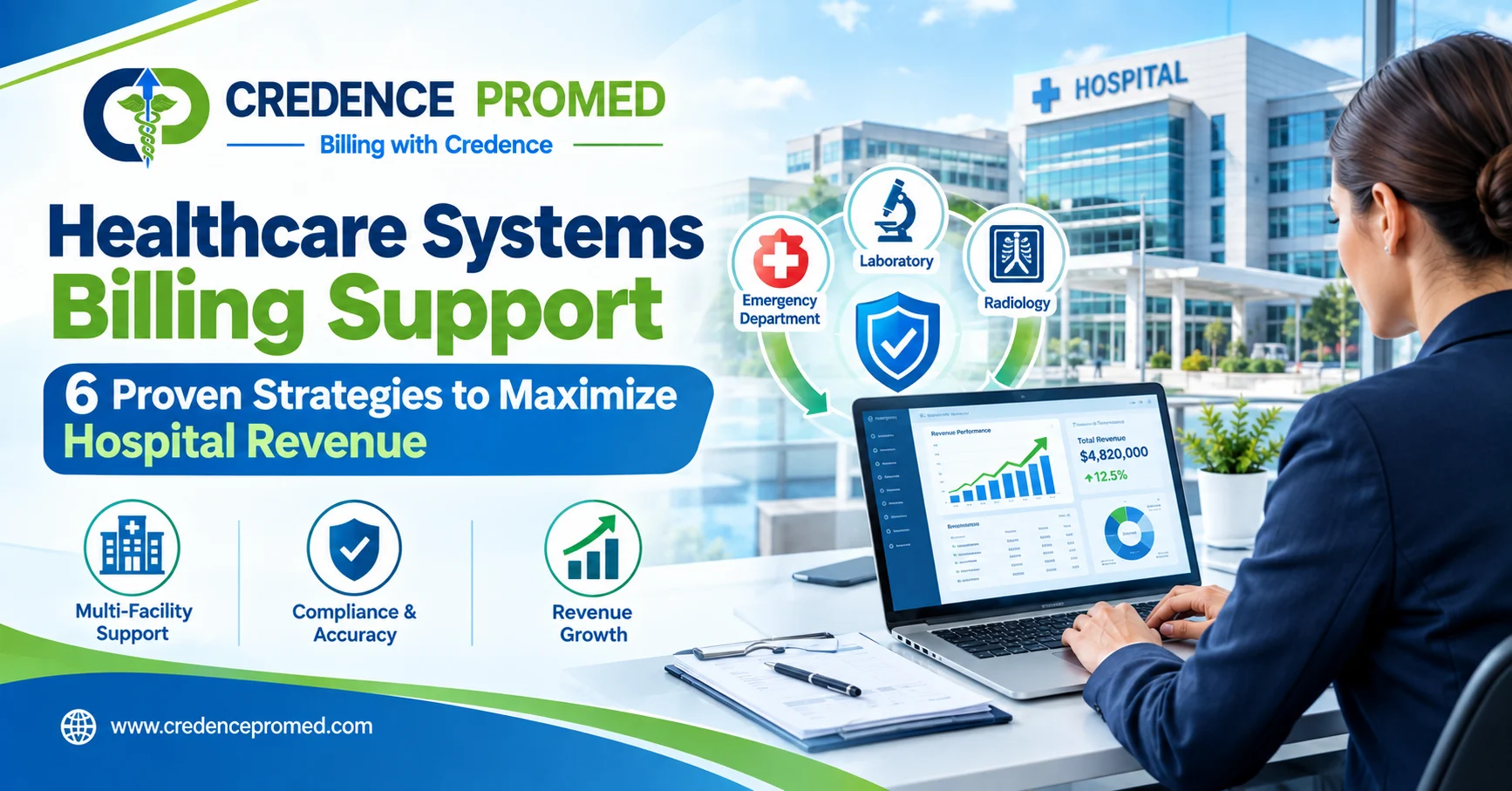
- Multiple departments and specialties — emergency, inpatient, outpatient, radiology, laboratory, and more — each with its own coding and billing rules
- High claim volume — thousands of claims monthly, where even small error rates translate into significant dollar amounts
- Complex payer contracts — negotiated rates, bundled payments, and value-based care arrangements that differ from standard fee-for-service billing
- Multi-site coordination — ensuring consistent billing practices and compliance across every facility under the system
Because of this scale, healthcare systems need billing infrastructure that can handle volume and complexity without sacrificing accuracy — something a generic, one-size-fits-all billing process typically can’t deliver.
Common Revenue Cycle Challenges for Healthcare Systems
Without strong Healthcare Systems Billing Support, these challenges can quietly drain revenue at scale.
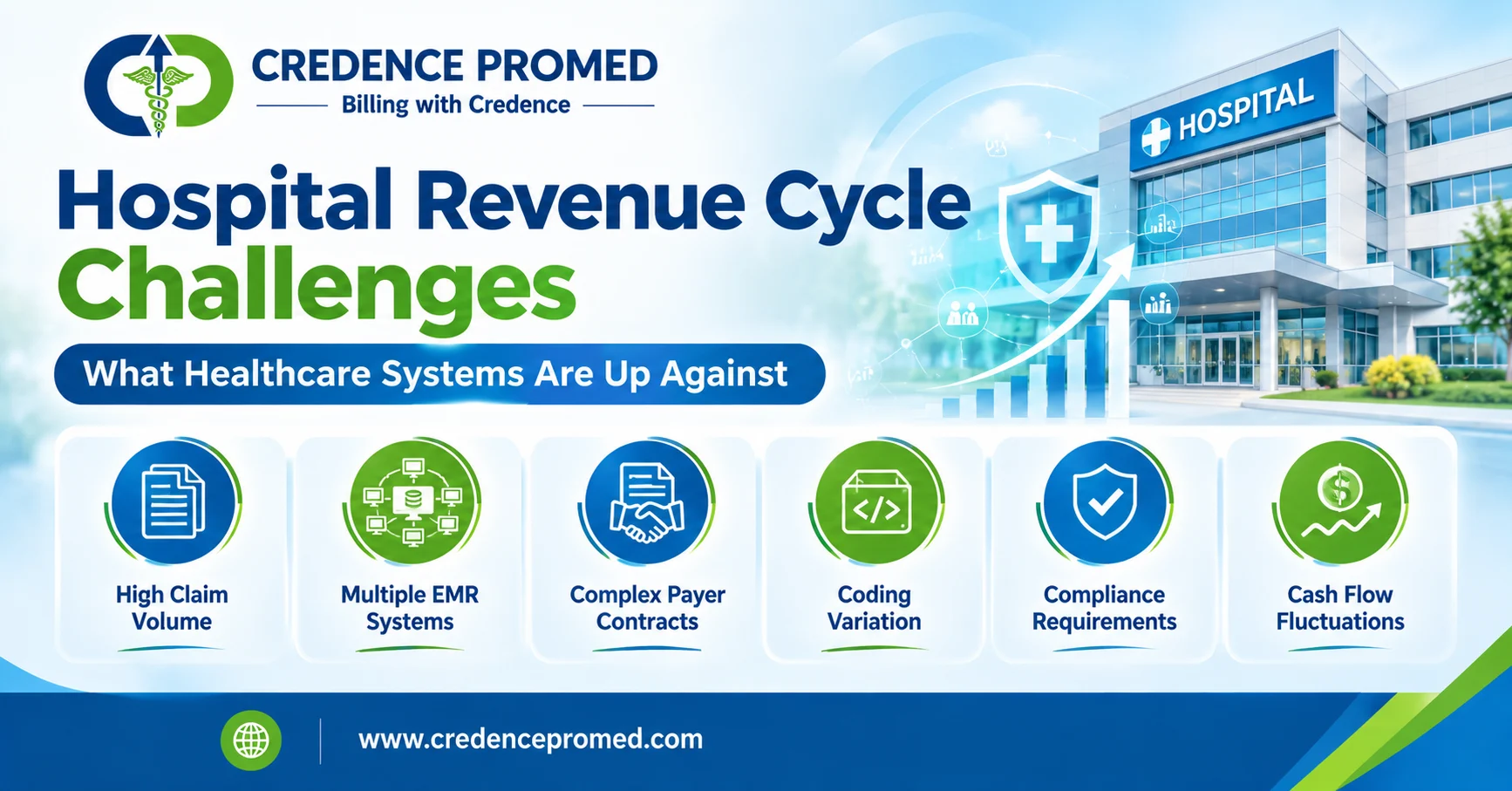
| Challenge | Impact on Revenue Cycle |
|---|---|
| High claim volume with limited staff | Backlogs in AR follow-up and denial resolution |
| Multiple EMR/billing systems across facilities | Inconsistent data and reporting across the organization |
| Complex, multi-payer contracts | Increased risk of underpayment going undetected |
| Departmental coding variation | Higher denial rates from inconsistent CPT/ICD-10 application |
| Regulatory and compliance complexity | Greater exposure to audits and compliance penalties |
| Patient volume fluctuations | Unpredictable cash flow without proactive AR management |
Each of these challenges shows exactly why generic billing processes fall short of what Healthcare Systems Billing Support actually requires.
What Effective Healthcare Systems Billing Support Looks Like
- Centralized oversight with department-level accuracy — a billing process that standardizes reporting and compliance across facilities while still respecting the coding nuances of each specialty
- Proactive denial management at scale — systems in place to catch and resolve denial patterns before they multiply across thousands of claims
- Contract and payment accuracy audits — regularly verifying that reimbursements match negotiated payer contract terms, since underpayments are easy to miss in high-volume environments
- Real-time reporting and visibility — leadership needs clear, consolidated financial reporting across the entire system, not siloed facility-by-facility numbers
- Scalable AR follow-up capacity — enough dedicated resources to keep pace with claim volume so outstanding balances don’t quietly age past the point of easy recovery
How Credence Promed Supports Hospitals & Healthcare Systems
Credence ProMed works with healthcare organizations that need billing support capable of matching their scale and complexity. Our approach includes:
- Multi-department billing expertise — supporting the coding and billing nuances of different departments and specialties under one coordinated process
- High-volume AR and denial management — dedicated follow-up capacity built to handle claim volumes that would overwhelm a smaller in-house team
- Payer contract awareness — reviewing reimbursements against negotiated terms to catch underpayments that are easy to miss at scale
- Consistent compliance standards — applying the same accuracy and documentation standards across every facility in the system
- Transparent, consolidated reporting — giving administrators clear visibility into revenue cycle performance across the entire organization, not just individual departments
Whether you’re managing a single hospital or a multi-facility health system, the goal is the same: a revenue cycle that scales with your organization instead of becoming a bottleneck.
Frequently Asked Questions
How is hospital billing different from physician practice billing? Hospital billing involves significantly higher claim volume, multiple departments with different coding requirements, more complex payer contracts, and greater regulatory oversight compared to a typical physician practice.
What causes the most revenue loss for large healthcare systems? Underpayments that go undetected against negotiated payer contracts, inconsistent coding across departments, and denial backlogs that outpace in-house AR follow-up capacity are among the most common sources of lost revenue.
Healthcare Systems Billing Support typically includes multi-department coding expertise, high-volume AR management, payer contract audits, and consolidated financial reporting.
Can outsourced billing support work for large, multi-facility organizations? Yes. Many health systems use outsourced or hybrid billing support specifically because it provides dedicated, scalable capacity for high claim volumes without the overhead of building an equivalent in-house team.
How often should a healthcare system audit its payer contracts for underpayment? Regular contract and payment audits — at minimum annually, though quarterly is preferable for high-volume systems — help catch underpayments before they accumulate into significant revenue loss.
Key Takeaway
Billing for hospitals and healthcare systems isn’t just a larger version of physician practice billing — it’s a fundamentally different operational challenge involving higher volume, more complexity, and greater financial stakes. Investing in reliable Healthcare Systems Billing Support is what separates organizations that protect revenue at scale from those that don’t.
📞 Get a Free Consultation Today!
Looking for billing and RCM support built for hospital or healthcare system scale? Contact Credence Promed today.
📞 Call us: 845-789-2849
📧 Email: info@credencepromed.com
🌐 Visit: www.credencepromed.com
