
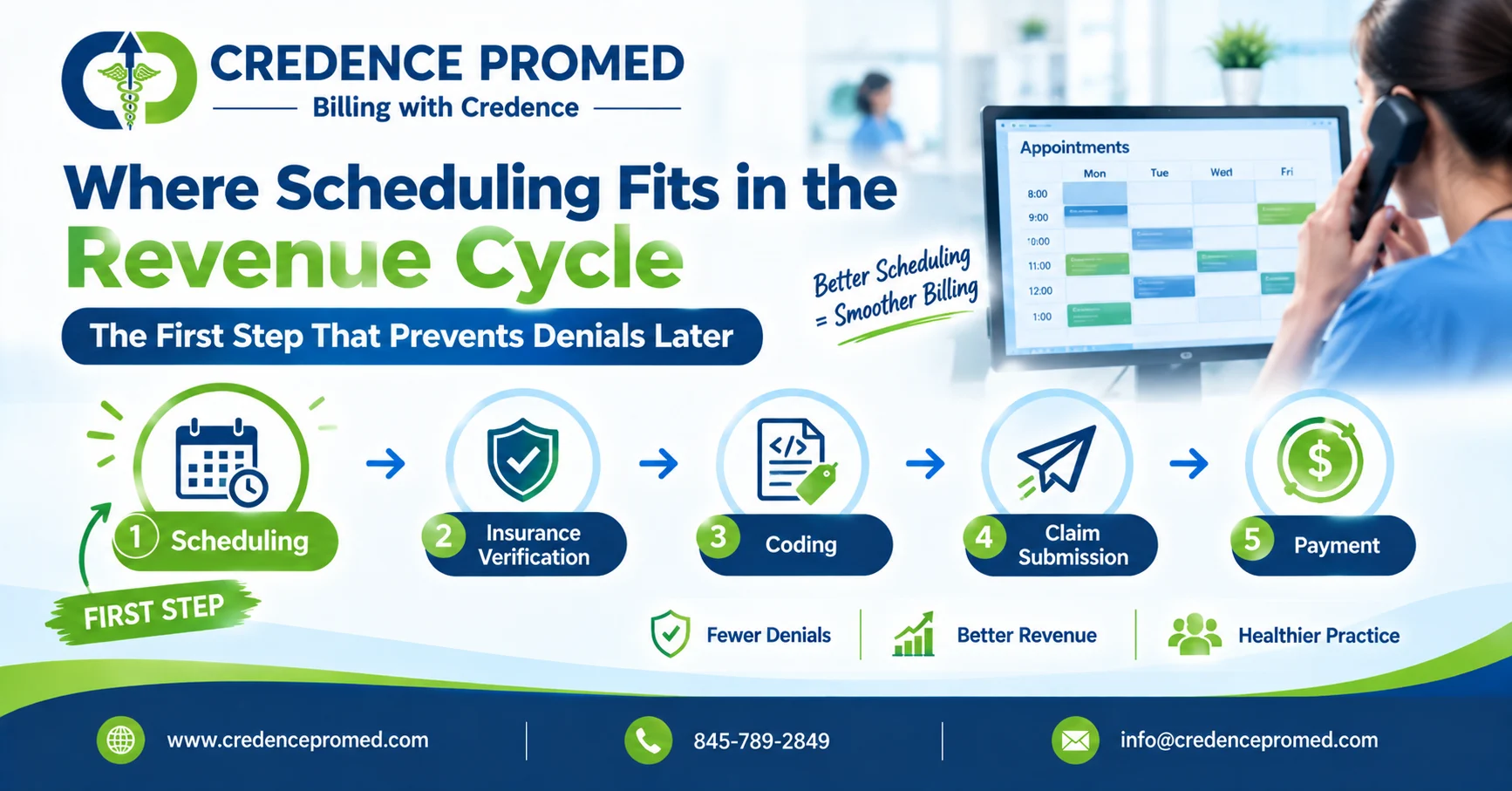
Healthcare appointment scheduling is usually treated as a front-desk task — separate from billing, coding, or revenue cycle management. In reality, healthcare appointment scheduling is the very first step of the revenue cycle, and mistakes made here rarely surface until weeks later, when a claim comes back denied. By then, the connection between a scheduling error and a lost payment is easy to miss.
In this guide, we look at how appointment scheduling directly impacts claim denials and revenue, the most common scheduling mistakes that cause downstream billing problems, and what a scheduling process built with revenue cycle awareness actually looks like.

Why Appointment Scheduling Is Part of the Revenue Cycle
Every claim starts with information gathered at scheduling: patient demographics, insurance details, and the reason for the visit. If any of that information is incomplete, outdated, or incorrect, it travels through the entire billing process before the error is caught — usually at the point of claim denial, which is the most expensive and time-consuming place to catch a mistake.
According to CMS guidelines, incomplete eligibility and demographic information collected upfront remains one of the leading causes of claim rejections nationwide.
Scheduling isn’t just about filling calendar slots. It’s the data-entry point that everything downstream — appointment scheduling revenue cycle, eligibility verification, coding, claim submission — depends on.
How Scheduling Errors Turn Into Claim Denials
| Scheduling Mistake | Downstream Billing Impact |
|---|---|
| Incomplete or incorrect insurance information collected | Claims submitted with wrong payer details are denied outright |
| No eligibility check at time of scheduling | Coverage issues aren’t caught until after the visit, when it’s too late to collect accurate payment upfront |
| Wrong visit type or reason for visit recorded | Coding doesn’t match the actual service, leading to medical necessity denials |
| Missing referral or prior authorization step | Services requiring pre-approval are performed without it, resulting in automatic denial |
| Duplicate or mismatched patient records | Claims get attached to the wrong account, delaying both payment and patient billing |
Each of these starts as a small, easily overlooked scheduling detail — but by the time it reaches the claims stage, it’s a denial that requires staff time to investigate, appeal, and resolve.
Industry data from AAPC consistently shows that front-end errors, including scheduling and registration mistakes, account for a significant share of preventable denials.
What Revenue-Cycle-Aware Scheduling Looks Like
- Insurance verification at the point of scheduling — not just at check-in, but as early as possible, so coverage issues can be resolved before the appointment.
- Complete demographic and payer data collection — confirming policy numbers, group IDs, and payer details match exactly what’s on file with the insurer.
- Authorization checks built into the scheduling workflow — lagging any visit type that requires prior authorization before it’s booked
- Clear communication between front-desk and billing staff — so scheduling isn’t operating in isolation from the rest of the revenue cycle
- Patient cost estimates communicated in advance — reducing billing disputes and improving collection rates after the visit
Practices that follow AHIMA’s revenue cycle best practices treat scheduling as a core compliance and billing checkpoint, not just an administrative task.
How Credence Promed Helps Close This Gap
Credence Promed’s Eligibility & Insurance Verification service is built specifically to catch the healthcare appointment scheduling issues that often originate at booking, before they ever reach the claims stage:
- Verifying coverage close to the appointment date — not weeks in advance, when details are more likely to have changed
- Confirming prior authorization requirements — flagging services that need payer approval before the visit happens
- Coordinating with front-desk workflows — so verified information flows cleanly into billing without rework
- Reducing denials tied to scheduling-stage errors — addressing the root cause instead of only managing denials after they occur
Because scheduling and billing are connected, closing the gap between them is one of the most effective ways to reduce denials before they start.
Frequently Asked Questions
Why does appointment healthcare appointment scheduling affect medical billing?
healthcare appointment scheduling is where patient and insurance information first enters the system. Any errors made there carry through eligibility verification, coding, and claim submission, often surfacing later as a denial.
Can eligibility be verified at the time of healthcare appointment scheduling?
Yes, and it’s one of the most effective ways to prevent denials. Checking coverage as early as possible — while still close enough to the appointment date to be accurate — gives staff time to resolve issues before the visit.
What’s the most common healthcare appointment scheduling error that leads to denials?
Incomplete or outdated insurance information collected at scheduling is one of the most frequent causes, since it directly affects whether a claim is submitted with accurate payer details.
Should healthcare appointment scheduling staff be trained on billing basics?
Yes. Front-desk staff don’t need to be coding experts, but understanding how their data entry affects claims helps prevent avoidable denials at the source.
Key Takeaway
Healthcare appointment scheduling isn’t separate from the revenue cycle — it’s the starting point of it. Practices that build eligibility checks, accurate data collection, and authorization awareness into the healthcare appointment scheduling process catch problems before they become denials, protecting both revenue and staff time spent on avoidable rework.
📞 Get a Free Consultation Today!
Looking to reduce denials that start before the visit even happens? Contact Credence Promed today.
📞 Call us: 845-789-2849
📧 Email: info@credencepromed.com
🌐 Visit: www.credencepromed.com
