
Cardiology practices face unique financial challenges. From complex coding requirements to frequent claim denials, managing the revenue cycle management for heart and vascular patients requires specialized expertise.
That’s why many cardiology practices are turning to cardiology billing services to streamline their revenue cycle, reduce denials, and improve cash flow.
In this blog, we’ll explore the key steps to mastering cardiology medical billing and how partnering with a medical billing company can help your practice thrive.
Why Cardiology Billing Is Different
Cardiology billing is more complex than general medical billing due to:
- Complex coding: Cardiology procedures like echocardiograms, cardiac catheterizations, and electrophysiology studies require specific CPT and ICD-10 codes. You can stay updated with the latest CMS coding guidelines to ensure compliance.
- Frequent denials: Insurance companies often deny cardiology claims due to coding errors, missing documentation, or medical necessity issues.
- Prior authorization requirements: Many cardiology procedures require prior authorization, which can delay payments.
- Multiple payers: Cardiology practices work with various insurance companies, each with its own rules and requirements.
A specialized cardiology billing services provider understands these challenges and has systems in place to address them, ensuring smooth revenue cycle management.
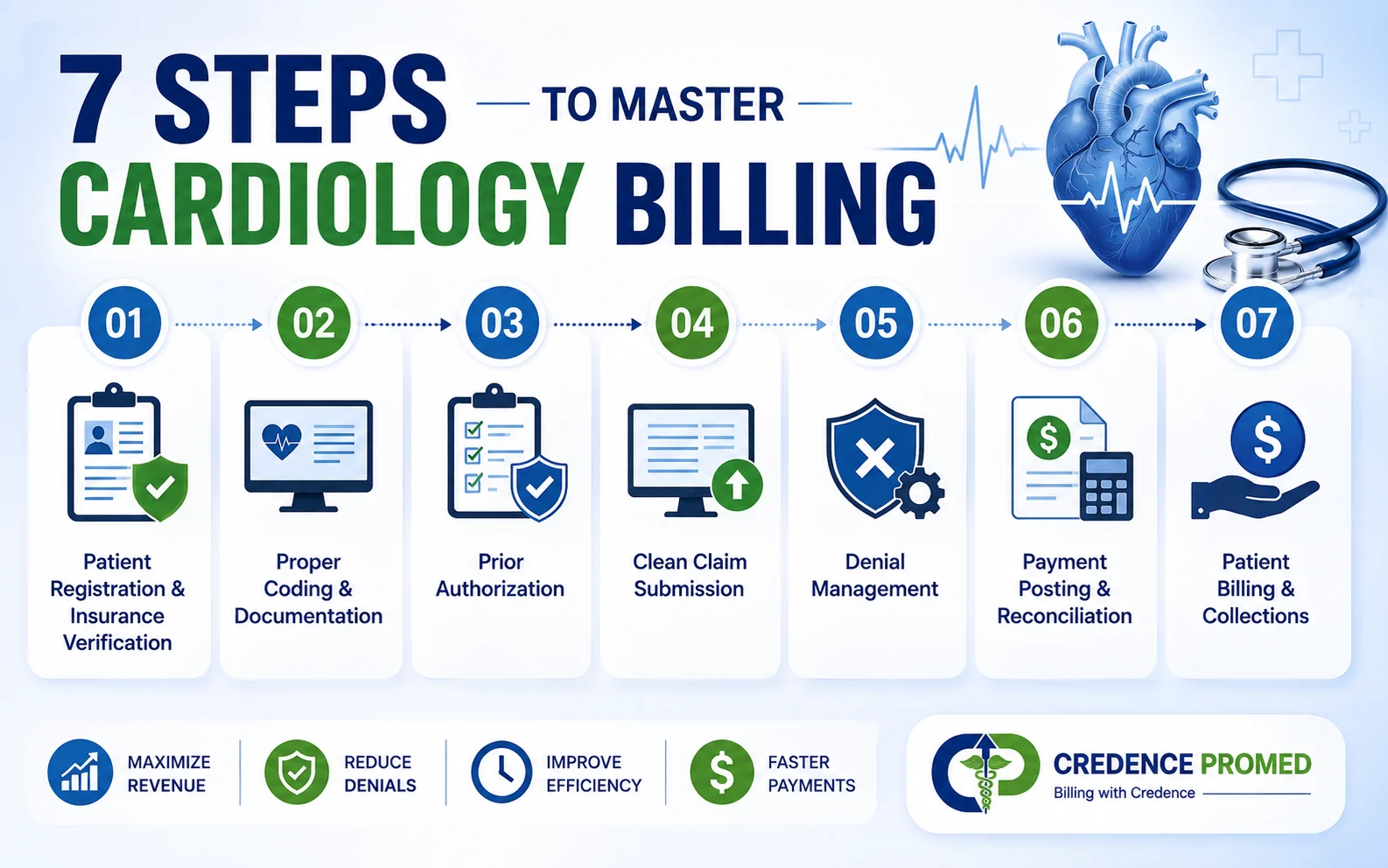
7 Key Steps to Master RCM for Cardiology Practices
Step 1: Accurate Patient Registration and Insurance Verification
The billing process starts before the patient even walks in. Accurate patient registration and insuranc eligibility verification are critical to avoid claim denials.
- Verify insurance eligibility and benefits.
- Check for prior authorization requirements.
- Collect accurate patient demographics and insurance details.
Step 2: Proper Coding and Documentation
Coding errors are one of the leading causes of claim denials in cardiology. Common cardiology procedures like echocardiograms, cardiac catheterizations, and stress tests have specific codes that must be used correctly.
- Use the latest CPT and ICD-10 codes.
- Refer to cardiology coding resources for accurate documentation.
- Ensure documentation supports the codes used.
- Stay updated on payer-specific coding requirements. Refer to cardiology coding resources for accurate documentation.
Step 3: Prior Authorization and Pre-Certification
Many cardiology procedures require prior authorization from the insurance company. Missing this step can result in claim denials or delayed payments.
- Identify procedures that require prior authorization.
- Submit authorization requests promptly.
- Follow up on pending authorizations.
Step 4: Clean Claim Submission
Submitting clean claims is essential for timely reimbursement. Clean claims are those that are error-free and complete.
- Double-check all patient and procedure details.
- Use claim scrubbing tools to catch errors before submission.
- Submit claims electronically for faster processing.
Step 5: Denial Management
Claim denials are common in cardiology. However, many denials can be appealed and resolved with the right denial management process.
- Track and analyze denial reasons.
- Appeal denied claims promptly.
- Implement corrective measures to prevent future denials.
Step 6: Payment Posting and Reconciliation
Once payments are received, they need to be posted to patient accounts accurately.
- Post payments from insurance companies and patients.
- Reconcile payments against claims submitted.
- Identify underpayments and take corrective action.
Step 7: Patient Billing and Collections
Patient responsibility is increasing, and collecting payments from patients can be challenging. Our patient billing services help practices stay on top of collections.
- Send clear and timely patient statements.
- Offer flexible payment plans.
- Follow up on overdue patient balances.
Benefits of Outsourcing Cardiology Billing Services
| Benefit | Explanation |
|---|---|
| Reduced denials | Experts handle coding, prior authorization, and claim submission correctly, improving overall revenue cycle management. |
| Faster payments | Clean claims get paid faster. |
| Cost savings | No need to hire and train an in-house billing team. |
| Focus on patient care | Doctors and staff can focus on treating patients, not billing. |
| Access to technology | Billing companies use advanced software for claim submission and tracking. |
How Credence Promed Can Help
At Credence Promed, we specialize in providing cardiology billing services that help heart and vascular practices improve their revenue cycle management.
Our team of certified coders and billing experts handles everything from insurance verification to denial management. We use the latest technology to ensure accurate claim submission and timely payments.
Following revenue cycle best practices can help you maximize revenue and reduce denials.
Our Cardiology Billing Services Include:
- Insurance eligibility verification
- Prior authorization management
- Medical coding and documentation
- Clean claim submission
- Denial management and appeals
- Payment posting and reconciliation
- Patient billing and collections
- A/R follow-up
- RCM reporting and analytics
Frequently Asked Questions (FAQ)
Q1. What are the most common cardiology billing errors?
Common errors include incorrect coding, missing prior authorization, incomplete documentation, and incorrect patient information.
Q2. Why do cardiology claims get denied frequently?
Cardiology claims are often denied due to coding errors, missing documentation, prior authorization issues, and medical necessity disputes.
Q3. Can I outsource cardiology billing?
Yes! Outsourcing to a specialized cardiology billing services provider like Credence Promed is a smart way to improve revenue and reduce denials.
Q4. How can I reduce claim denials in my cardiology practice?
Focus on accurate coding, prior authorization, clean claim submission, and proactive denial management.
Q5. What is the cost of outsourcing cardiology billing?
Most companies charge a percentage of collected revenue (usually 4-8%). This is often more cost-effective than maintaining an in-house team.
Conclusion
Cardiology billing is complex, but with the right partner, you can streamline your revenue cycle and improve your practice’s financial health. By outsourcing your cardiology billing services to a trusted medical billing company, you can reduce denials, get paid faster, and focus on patient care.
Following revenue cycle best practices can help you maximize revenue and reduce denials.
Ready to take your cardiology practice to the next level? Contact Credence Promed today for a free consultation.
📞 Get a Free Consultation Today!
Are you looking for reliable cardiology billing services? Contact Credence Promed today.
📞 Call us: 845-789-2849
📧 Email: info@credencepromed.com
🌐 Visit: www.credencepromed.com
