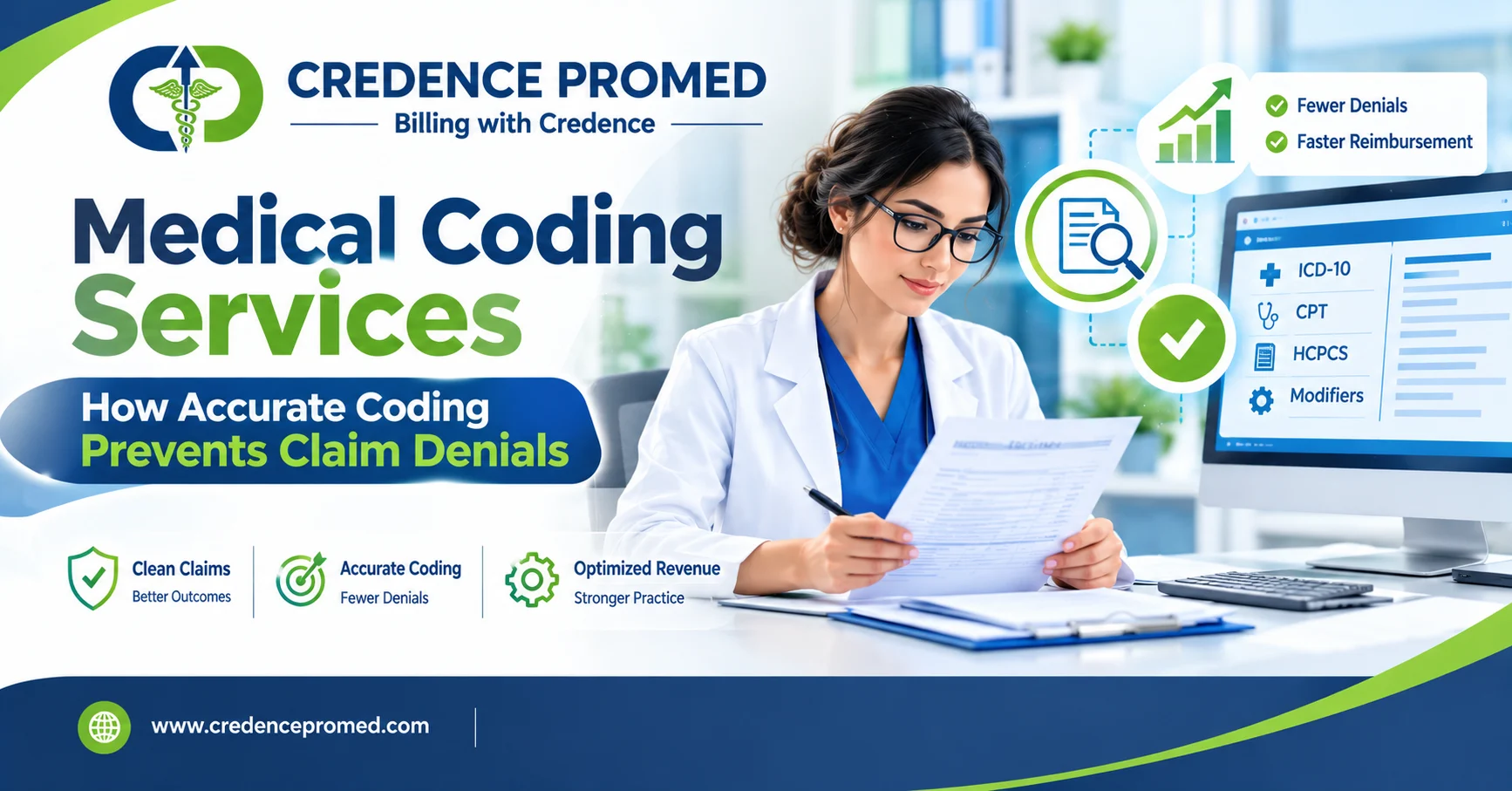
Medical coding services are the foundation that every insurance claim is built on — yet coding errors remain one of the most common, and most preventable, reasons claims get denied. A single mismatched code between a diagnosis and a procedure can turn a clean, payable claim into a weeks-long denial and appeal process.
In this guide, we explain what medical coding services actually involve, how coding connects directly to billing and denials, and what accurate coding looks like in practice.
What Are Medical Coding Services?
Medical coding is the process of translating a provider’s clinical documentation — diagnoses, procedures, treatments, and services — into standardized alphanumeric codes that payers use to process claims. The three main coding systems used in the U.S. are:
- ICD-10-CM — codes for diagnoses (what condition the patient has)
- CPT (Current Procedural Terminology) — codes for procedures and services performed
- HCPCS Level II — codes for supplies, equipment, and services not covered by CPT, such as DMEPOS items
Medical coding services take a provider’s notes and convert them into the exact combination of codes a payer requires to recognize the service as medically necessary and reimbursable.
Why Coding Accuracy Directly Affects Your Revenue Cycle
- Denials start with mismatched codes. A diagnosis code that doesn’t support the medical necessity of a procedure code is one of the most common denial triggers industry-wide.
- Undercoding loses revenue. Coding a service at a lower level than what was actually performed means the practice is paid less than it earned — often without anyone noticing.
- Overcoding creates compliance risk. Coding for a higher level of service than documentation supports can trigger audits, recoupment demands, and in serious cases, allegations of fraud.
- Specialty coding has its own complexity. Cardiology, orthopedics, and other specialties involve procedure codes with specific bundling and modifier rules that general coding knowledge often misses.
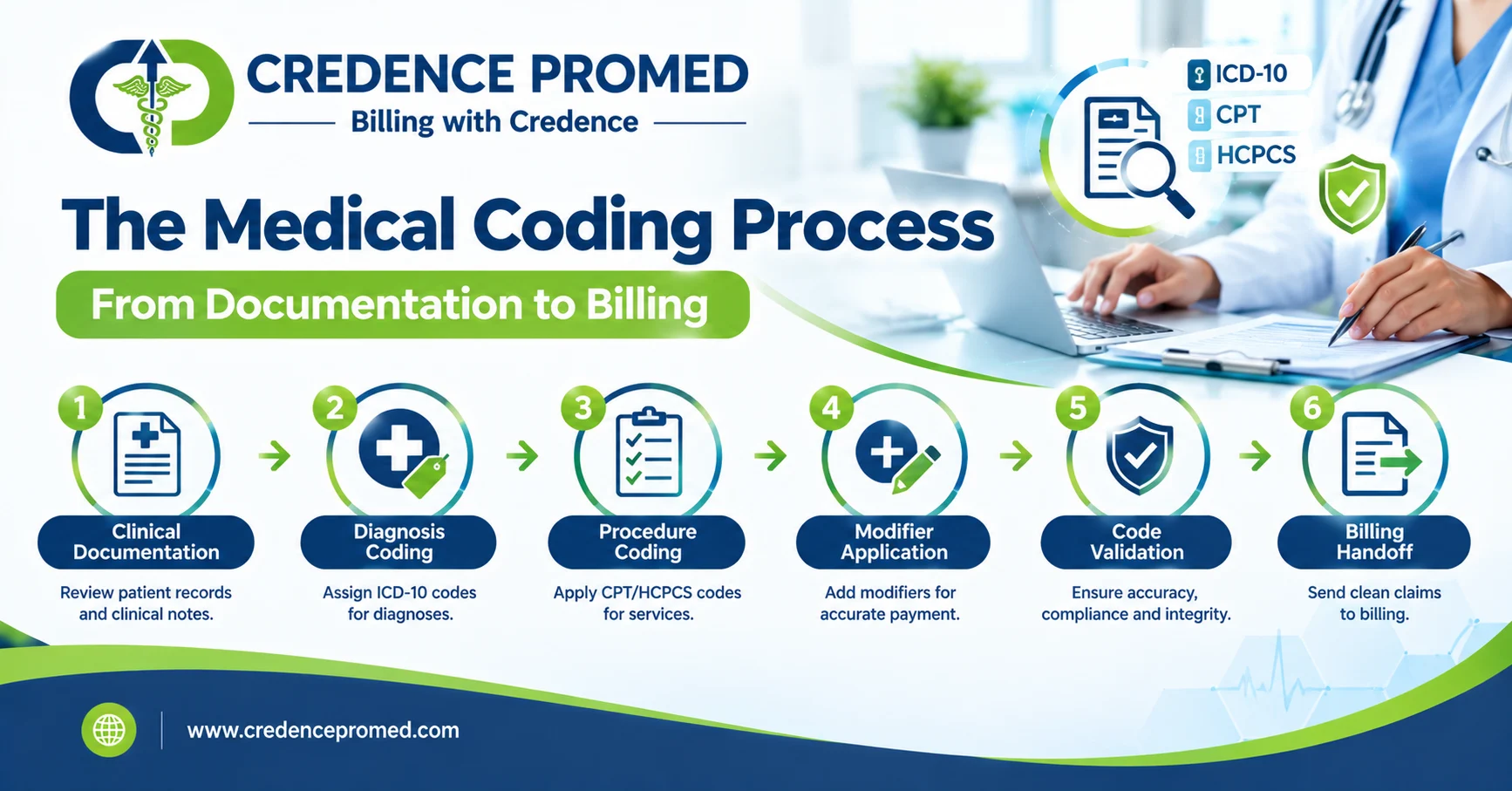
The Medical Coding Process: Step-by-Step
| Step | What Happens |
|---|---|
| 1. Documentation Review | Coder reviews the provider’s clinical notes for the visit or procedure |
| 2. Diagnosis Coding (ICD-10) | Assigning the correct diagnosis code(s) that reflect the patient’s condition |
| 3. Procedure Coding (CPT/HCPCS) | Assigning codes for every service, test, or procedure performed |
| 4. Modifier Application | Adding modifiers where needed to clarify circumstances (e.g., bilateral procedures, multiple providers) |
| 5. Code Validation | Cross-checking that diagnosis and procedure codes align and support medical necessity |
| 6. Handoff to Billing | Coded claim moves into the billing system for submission to the payer |
Coding accuracy at every one of these steps is what determines whether a claim is paid the first time or bounces back as a denial.
Common Medical Coding Mistakes That Lead to Denials
- Mismatched diagnosis and procedure codes — the payer can’t confirm the service was medically necessary for the stated condition
- Missing or incorrect modifiers — especially common with bilateral procedures, multiple units, or same-day services
- Outdated code sets — ICD-10 and CPT codes update annually; using a retired code results in automatic rejection
- Unbundling errors — billing separately for procedures that should be billed together under a single bundled code
- Insufficient documentation to support the code — even a correct code can be denied on audit if the clinical note doesn’t clearly support it
How Credence Promed Can Help
Credence Promed’s medical coding services are built to catch these issues before a claim is ever submitted:
- Certified coding expertise across specialties, including cardiology, DMEPOS, and general practice
- Code validation against documentation to ensure every claim reflects what was actually performed and supports medical necessity
- Modifier accuracy checks to prevent avoidable denials tied to missing or incorrect modifiers
- Ongoing code set updates so your claims always reflect the current ICD-10, CPT, and HCPCS versions
- Seamless coding-to-billing handoff that reduces the back-and-forth between coding corrections and claim resubmission
Accurate coding is the first line of defense against denials — and it’s most effective when it’s built directly into your billing workflow rather than treated as a separate, disconnected step.
Frequently Asked Questions
What’s the difference between medical coding and medical billing?
Medical coding translates clinical documentation into standardized codes (ICD-10, CPT, HCPCS). Medical billing uses those codes to create and submit the actual claim for payment. Coding happens first; billing depends on its accuracy.
How often do medical codes change?
ICD-10 and CPT code sets are updated annually, typically effective October 1 (ICD-10) and January 1 (CPT). Using outdated codes after these dates is a common cause of claim rejections.
What is a modifier in medical coding?
A modifier is a two-character code added to a CPT code to provide additional information about a procedure — such as indicating it was performed on both sides of the body, or that multiple procedures occurred during the same visit.
Can coding errors trigger an audit?
Yes. Consistent overcoding, upcoding, or coding patterns that don’t match documentation can flag a practice for a payer audit, which may result in recoupment of previously paid claims.
Should coding be handled in-house or outsourced?
It depends on practice size and specialty complexity. Many practices outsource coding to ensure certified expertise across evolving code sets, particularly for specialty procedures with complex bundling and modifier rules.
Key Takeaway
Medical coding services are the foundation the entire billing process is built on. A single coding error — a missing modifier, a mismatched diagnosis, an outdated code — can turn a straightforward claim into a denial that costs time and revenue to fix. Practices that invest in accurate, specialty-aware coding consistently see fewer denials and faster, cleaner reimbursement across their entire revenue cycle.
📞 Get a Free Consultation Today!
Looking for accurate, compliant medical coding support? Contact Credence Promed today.
📞 Call us: 845-789-2849
📧 Email: info@credencepromed.com
🌐 Visit: www.credencepromed.com
