
Every healthcare practice, whether a solo physician clinic or a multi-specialty group, depends on one process that quietly determines how quickly it can start getting paid: provider credentialing. Without proper credentialing, even the most skilled doctor cannot bill insurance companies, join preferred networks, or legally see patients under certain payer plans. Yet credentialing is often misunderstood, delayed, or handled incorrectly, leading to lost revenue and frustrated staff.
In this guide, we break down what provider credentialing services actually involve, why they matter for your practice’s revenue cycle, and how outsourcing this process can save you time, money, and compliance headaches.
What Are Provider Credentialing Services?
Provider credentialing is the process of verifying a healthcare provider’s qualifications — including education, training, licensure, work history, and malpractice history — so they can be approved to participate with insurance networks (payers) and receive reimbursement for services rendered.
This process applies to physicians, nurse practitioners, physician assistants, dentists, therapists, and other licensed healthcare professionals. Credentialing is required not only when a provider joins a new practice but also periodically thereafter, since most insurance panels require re-credentialing every two to three years.
Why Credentialing Matters for Your Practice
Many practices underestimate how directly credentialing affects cash flow. Consider these points:
- No credentialing, no reimbursement. If a provider sees patients before their credentialing is approved, claims submitted to insurance companies are often denied or delayed indefinitely.
- Patient access depends on it. Patients frequently choose providers based on which insurance networks they are part of. A provider who isn’t credentialed with major payers may lose potential patients.
- Compliance risk. Incomplete or inaccurate credentialing files can trigger audits, payer contract terminations, or even allegations of fraud in serious cases.
- New hires can’t bill immediately. Practices that don’t plan credentialing in advance often face a 60–120 day gap where a new provider is working but not generating billable revenue.
The Credentialing Process: Step-by-Step
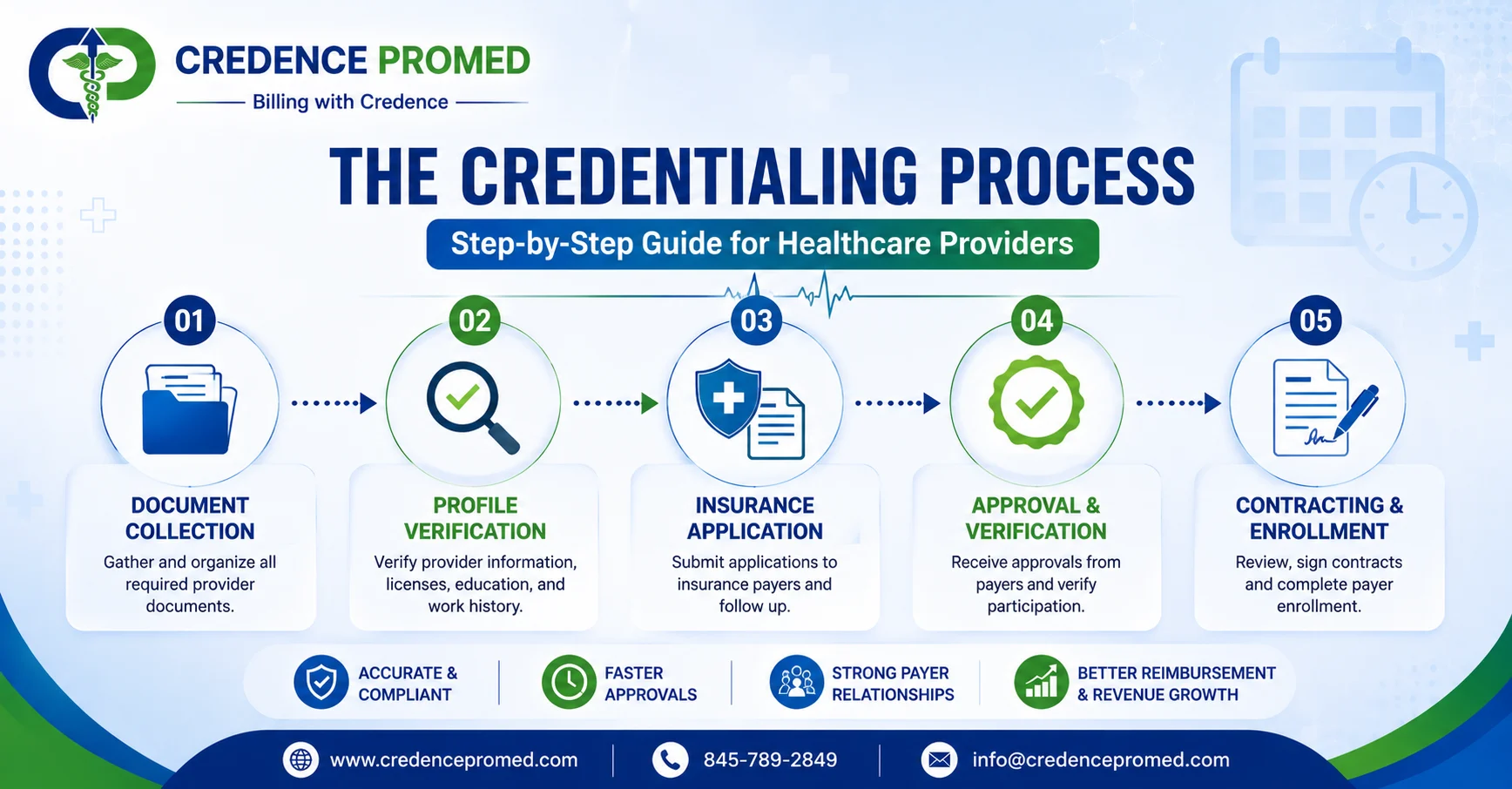
| Step | What Happens | Typical Timeframe |
|---|---|---|
| 1. Document Collection | Gathering licenses, diplomas, DEA certificate, malpractice insurance, work history, and references | 1–2 weeks |
| 2. CAQH Profile Setup | Creating or updating the provider’s CAQH ProView profile, used by most major payers | 1 week |
| 3. Payer Application Submission | Submitting applications to Medicare, Medicaid, and commercial insurance panels | 1–2 weeks |
| 4. Primary Source Verification | Payers verify education, licensure, and background directly with issuing institutions | 30–60 days |
| 5. Committee Review & Approval | Payer credentialing committee reviews the file and approves or requests additional info | 15–45 days |
| 6. Contracting & Effective Date | Provider receives a participation agreement and an effective date to begin billing | 1–2 weeks |
| 7. Re-Credentialing (Ongoing) | Renewal of credentials, usually required every 2–3 years per payer | Recurring |
As the table shows, the full process can realistically take 90 to 150 days depending on the payer, which is why starting early — ideally three to four months before a provider’s start date — is critical.
Common Mistakes in Provider Credentialing Services
- Waiting too long to start the process — leading to revenue gaps when a new provider joins.
- Incomplete or outdated CAQH profiles — a leading cause of application delays.
- Missing re-credentialing deadlines — resulting in a provider being dropped from a network without warning.
- Inconsistent data across applications — small discrepancies (like address formatting) can trigger manual review and delay approval by weeks.
- No dedicated tracking system — practices managing credentialing manually often lose track of expiration dates and follow-up requirements.
How Credence Promed Can Help
At Credence Promed, provider credentialing is one of the core services we manage for healthcare practices of all sizes — from solo providers to multi-specialty groups. Here’s how our team supports you:
- End-to-end credentialing management — from CAQH profile setup to final payer approval
- Faster payer enrollment — established relationships with commercial insurers, Medicare, and Medicaid
- Proactive re-credentialing tracking — so your providers never lapse out-of-network
- Error-free applications — careful review before submission to avoid costly delays
- Seamless integration with billing — providers can start billing the moment they’re approved, with no revenue gap
- Transparent status updates — you always know where each application stands
- Our re-credentialing services ensure your providers never lapse out of network.
Why Outsource Provider Credentialing Services?
Handling credentialing in-house requires dedicated staff time, deep familiarity with payer-specific requirements, and constant follow-up with insurance companies. Many practices find that outsourcing to a specialized medical billing and credentialing partner offers real advantages:
- Faster turnaround through established payer relationships and experienced staff who know exactly what each panel requires
- Fewer denials and delays due to accurate, complete submissions the first time
- Proactive re-credentialing tracking so your providers never lapse out of network
- More time for your staff to focus on patient care and daily operations instead of paperwork
- Better cash flow since providers can start billing sooner
Final Thoughts
Provider credentialing may not be the most visible part of running a healthcare practice, but it directly impacts how quickly you get paid, which networks you can serve, and how compliant your practice remains over time. Whether you’re onboarding a new provider or managing re-credentialing for your existing team, having a structured, proactive process — or a trusted credentialing partner — makes all the difference.
If your practice is struggling with credentialing delays, denied claims, or simply doesn’t have the bandwidth to manage the process internally, partnering with an experienced medical billing and credentialing service can help you avoid revenue gaps and keep your practice running smoothly.
Frequently Asked Questions
How long does provider credentialing take?
Most payers take between 90 and 150 days from submission to final approval, though some commercial insurers move faster and Medicare/Medicaid can sometimes take longer depending on the state.
What is CAQH and why does it matter?
CAQH ProView is a centralized database that most major insurance companies use to pull provider information during credentialing. Keeping this profile accurate and up to date is one of the fastest ways to avoid unnecessary delays.
Can a provider see patients before credentialing is complete?
Technically yes, but claims for those visits may be denied or require the practice to bill under a supervising provider’s credentials, which is not sustainable long term and can create compliance issues.
How often does re-credentialing need to happen?
Most payers require re-credentialing every two to three years, though timelines vary. Missing a renewal deadline can result in a provider being removed from the network without notice.
Is credentialing the same as contracting?
No. Credentialing verifies a provider’s qualifications, while contracting is the negotiation and signing of the actual participation agreement with the payer that sets reimbursement rates and terms. Both steps are required before billing can begin.
Key Takeaway
Credentialing is not a one-time task — it is an ongoing responsibility that directly affects your practice’s revenue, compliance standing, and patient access. Practices that treat credentialing as a proactive, continuously managed process (rather than a reactive scramble when a new hire starts) consistently see fewer billing disruptions and faster reimbursement timelines.
For growing practices adding new providers regularly, or established practices juggling multiple payer renewal dates, professional credentialing support isn’t just a convenience — it’s a direct investment in cash flow stability.
📞 Get a Free Consultation Today!
Are you looking for reliable provider credentialing services? Contact Credence Promed today.
📞 Call us: 845-789-2849
📧 Email: info@credencepromed.com
🌐 Visit: www.credencepromed.com
