
What is medical billing? Medical billing is the process of translating healthcare services into insurance claims, submitting those claims to payers, and following up until the provider is fully reimbursed. It’s the financial backbone connecting every patient visit to the revenue that keeps a practice running — and it’s far more involved than simply “sending a bill.”
Whether you’re a new practice owner trying to understand how your revenue actually gets collected, or an administrator looking to tighten up an existing process, this guide walks through exactly how medical billing works, the full revenue cycle it’s part of, and where practices most commonly lose revenue along the way.

What Is Medical Billing, Exactly?
Medical billing is the administrative process healthcare providers use to submit, track, and collect payment for the services they deliver. It starts the moment a patient’s visit is documented and ends only when the claim is fully paid — by the insurance company, the patient, or both.
Unlike a simple invoice, a medical claim has to be coded correctly (using standardized codes like CPT and ICD-10), matched against the patient’s specific insurance plan, and formatted to meet each payer’s individual submission rules. A single error in any of these areas can result in a denied or delayed claim.
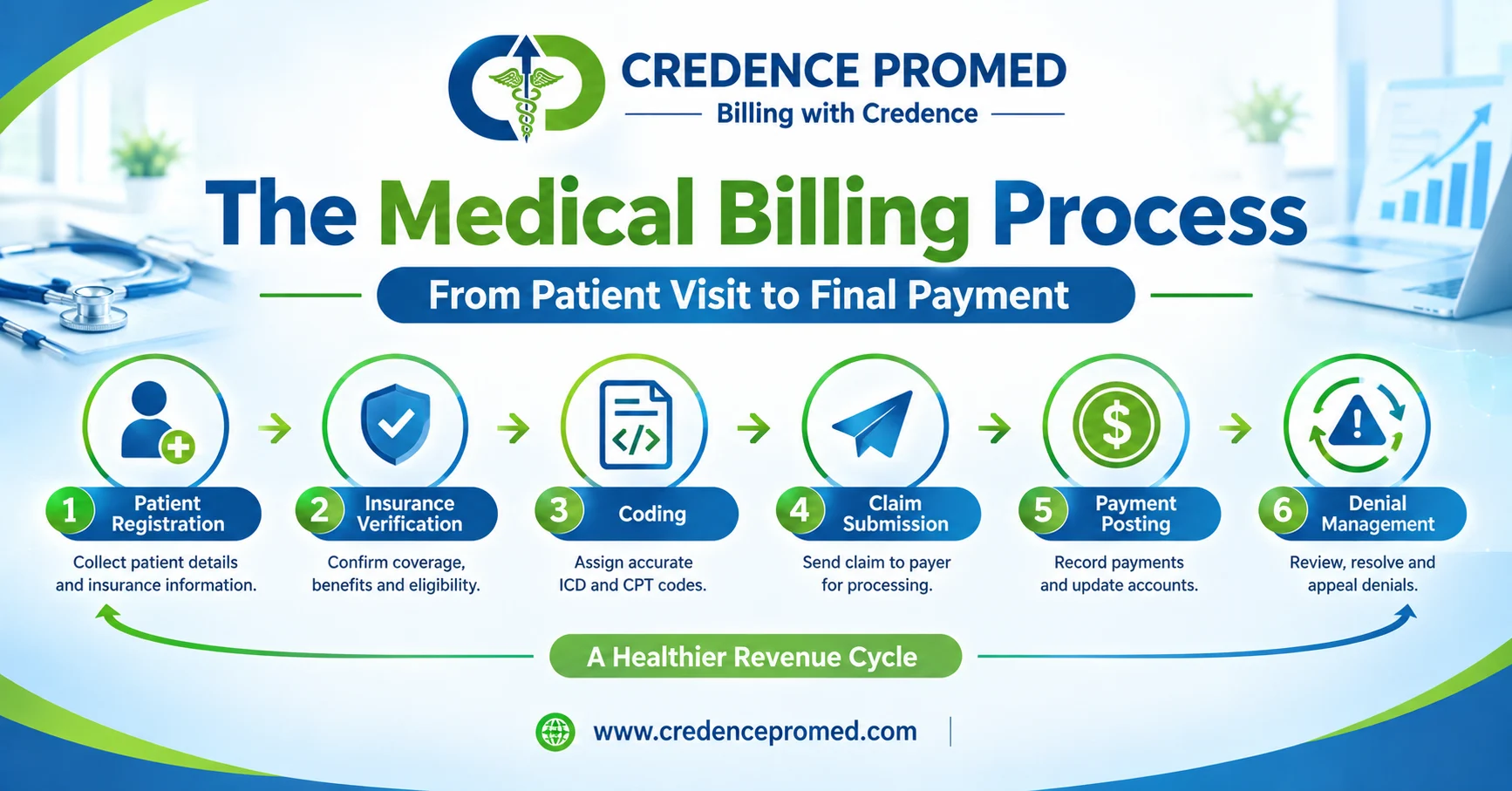
The Medical Billing Process: Step-by-Step
| Step | What Happens |
|---|---|
| 1. Patient Registration | Collecting patient demographics and insurance information at scheduling or check-in |
| 2. Eligibility & Insurance Verification | Confirming active coverage, benefits, and any prior authorization requirements before the visit |
| 3. Medical Coding | Translating the provider’s documentation into standardized CPT, ICD-10, and HCPCS codes |
| 4. Charge Entry & Claim Creation | Compiling coded services into a formatted claim ready for payer submission |
| 5. Claim Submission | Sending the claim electronically to the insurance payer, typically through a clearinghouse |
| 6. Payer Adjudication | The payer reviews the claim and decides to approve, partially approve, or deny it |
| 7. Payment Posting | Recording the payment received from the payer against the patient’s account |
| 8. Denial Management & Appeals | Identifying why a claim was denied and resubmitting or appealing as needed |
| 9. Patient Billing | Collecting any remaining patient responsibility — copay, deductible, or coinsurance |
This entire sequence is often referred to as the revenue cycle, and every step depends on the accuracy of the one before it. A mistake at registration or eligibility verification, for example, tends to surface much later as a denied claim.
Medical Billing vs. Revenue Cycle Management (RCM)
These terms are often used interchangeably, but they’re not quite the same thing:
- Medical billing refers specifically to the claims submission and collection process described above.
- Revenue cycle management is the broader umbrella — it includes billing, but also covers scheduling, eligibility verification, credentialing, coding accuracy, denial prevention, and financial reporting across the entire patient journey.
In other words, medical billing is one critical piece of a much larger RCM strategy.
Common Reasons Medical Billing Goes Wrong
- Eligibility errors — outdated or unverified insurance information is one of the single biggest causes of claim denials.
- Coding mistakes — incorrect or mismatched CPT/ICD-10 codes trigger automatic rejections.
- Missing prior authorization — services performed without required payer approval are frequently denied outright.
- Credentialing gaps — a provider who isn’t properly credentialed with a payer cannot bill that payer at all, regardless of documentation quality.
- Slow or inconsistent follow-up — unworked denials and unpaid claims quietly accumulate into significant lost revenue over time.
Why Practices Outsource Medical Billing
Handling billing in-house requires dedicated staff, ongoing training on payer rule changes, and constant follow-up — resources many practices would rather direct toward patient care. Outsourcing to an experienced billing partner typically offers:
- Fewer denials through accurate coding and proactive eligibility checks
- Faster reimbursement due to clean, first-pass claim submissions
- Dedicated follow-up on unpaid and denied claims
- Ongoing compliance with evolving payer and CMS requirements
How Credence Promed Supports the Full Revenue Cycle
Credence Promed provides end-to-end support across every stage of the billing process described above, including:
- Eligibility & Insurance Verification — confirming coverage and authorization before the visit
- Provider Credentialing Services — ensuring providers are properly enrolled with payers before billing begins
- AR Follow-Up — actively working unpaid and outstanding claims until resolved
- Claim Denial Reduction Strategies — identifying root causes of denials and preventing repeat errors
- Specialty billing expertise, including Cardiology Billing Services and DMEPOS Billing, Audit & Accreditation
Together, these services are designed to keep every stage of the revenue cycle moving — from the moment a patient is scheduled to the moment the claim is fully paid.
Frequently Asked Questions
What is medical billing in simple terms? Medical billing is the process of turning a patient’s healthcare visit into an insurance claim, submitting it to the payer, and collecting payment for the services provided.
What is the difference between medical billing and medical coding? Medical coding translates a provider’s documentation into standardized codes (CPT, ICD-10). Medical billing uses those codes to create and submit the actual claim for payment. They’re closely related but distinct functions.
How long does the medical billing process take? A clean claim can be paid within 2–4 weeks. Claims that are denied or require appeals can take significantly longer, sometimes months, depending on the payer and the issue.
Why do medical claims get denied? The most common reasons include eligibility errors, incorrect coding, missing prior authorization, and credentialing issues — most of which are preventable with a proactive process.
Should a small practice handle billing in-house or outsource it? It depends on staff bandwidth and expertise. Many small to mid-sized practices find outsourcing more cost-effective once they factor in denial rework, staff turnover, and the cost of delayed reimbursement.
Key Takeaway
Medical billing is far more than sending an invoice — it’s a multi-step process where a single error at any stage can delay or eliminate revenue a practice has already earned. Understanding each step, from eligibility verification through payment posting, is the first step toward reducing denials and improving cash flow. Practices that invest in getting this process right — whether in-house or through an experienced billing partner — consistently see faster, more predictable reimbursement.
📞 Get a Free Consultation Today!
Looking for reliable, end-to-end medical billing support? Contact Credence Promed today.
📞 Call us: 845-789-2849
📧 Email: info@credencepromed.com
🌐 Visit: www.credencepromed.com
